Partager
Printer-friendly versionSend to friend

Current Size: 100%

Ruelle des Chats et cour de Mortier d'Or

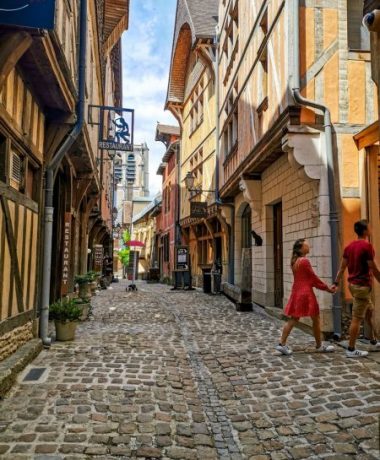
The Rue Maillard in the 15th century was soon called by its inhabitants the «ruelle des Chats» (cat alley), which became its official name. «The roofs, by dint of being contemplated over the centuries, have absorbed a certain shared tenderness.

«Cats jump from one attic to another with no danger of a false movement.» Lucien Morel-Payen.


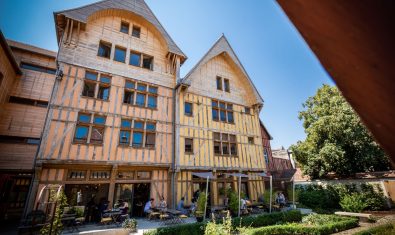
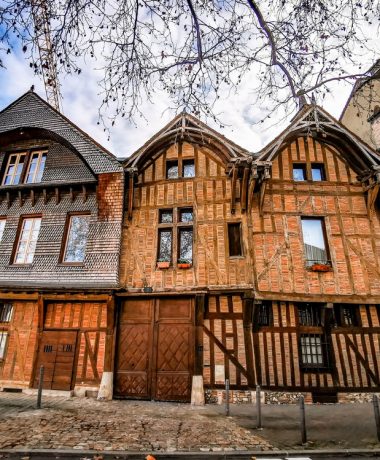
Paved in the old style, similar to the streets of Troyes in the 13th century, the ruelle des Chats has, as was the custom at the time, one central gutter. The privileged classes walked on the upper side of the street, so as not to soil their clothes. Sombre but charming, it leads to the very pretty cour du Mortier d’Or, from which you can view the rear of the half-timbered houses with their beautiful curved galleries. The ends of the beams are sculpted with figures that often evoke warfare; perhaps this place was used by soldiers. The entire area was restored in 1981 by the Compagnons du Devoir.


Notice as well the old lighting. In 1534, the city council decided to install public lighting in Troyes during the time of the foires de Champagne, using tallow candles placed in lanterns. In 1766, there were 150 public lanterns lighted in wintertime on the main streets. Tallow made way for oil in 1800 and then gas in 1842. Electricity arrived at the start of the 20th century.


The rue du Mortier d’Or used to be part of the rue des Quinze-Vingts. The latter owes its name to the house at n°3, owned by the Hospice des Quinze-Vingts, founded in Paris by King Saint Louis for 300 knights who returned from the Crusades, their eyes having been gouged out by their enemies. The hospice had 15 rooms and 20 beds.


Alongside the cour du Mortier d’Or, at no. 25 of the ruelle des Chats, the beautiful half-timbered green house was built in the 16th century for Pierre de Mauroy, Lord of Colaverdey, mayor of Troyes from 1517 to 1521 and relative of Jean de Mauroy, whose restored hôtel, not far from here, hosts the Maison de l’Outil et de la Pensée ouvrière.


Place Jean Jaurès 

The former rue Notre-Dame, today called rue Emile Zola, widens to the west into a vast triangular plaza called the Marché-au-blé (wheat market).

Trade in cereals, a staple of medieval society, was busy and lucrative and explains the many inns and hotels around the square over the centuries, for example the Hôtel du Mulet and the Hôtel des Trois Rois.


But the square was also used for public executions. In the 16th century there were two pillories there, where criminals were exposed to the public, and a gallows, where the condemned were hanged. The French Revolution considered that executions would be less cruel by guillotine, one of which was set up on this square.


Among the famous condemned criminals, history has retained the name of Claude Gueux, imprisoned at Clairvaux and guillotined in 1832. His story and execution caused indignation in Victor Hugo, who published a famous pamphlet on him and against the death penalty. During a voyage in 1839, he made a stop here. “I have long thought about this poor, intelligent and noble worker, dead seven years ago in this place, owing to the fault of society that was unable to raise the child and correct the man.”


The large building that lines the square was the Bourse du travail (labour exchange) from 1905 to 2006. It was built in 1837 and used as the hosiery hall. Manufacturers from the entire region came to sell their products, after which the building housed the trade unions of Troyes.


The house at n° 28 was the birthplace of Edouard Herriot (1872-1957), who was mayor of Lyon, senator, president of the council and president of the National Assembly.


In 1919, the square was re-named after Jean Jaurès, an eminent French politician, deputy of Carmaux (Tarn), socialist and pacifist, who was assassinated in Paris on the eve of World War I.

Renovated in 2005 and opened up to pedestrian traffic, the square is now covered in Etrochey paving stones.


Entrance Rue Champeaux and rue Charbonnet
Entrance rue Champeaux and rue des Quinze vingt